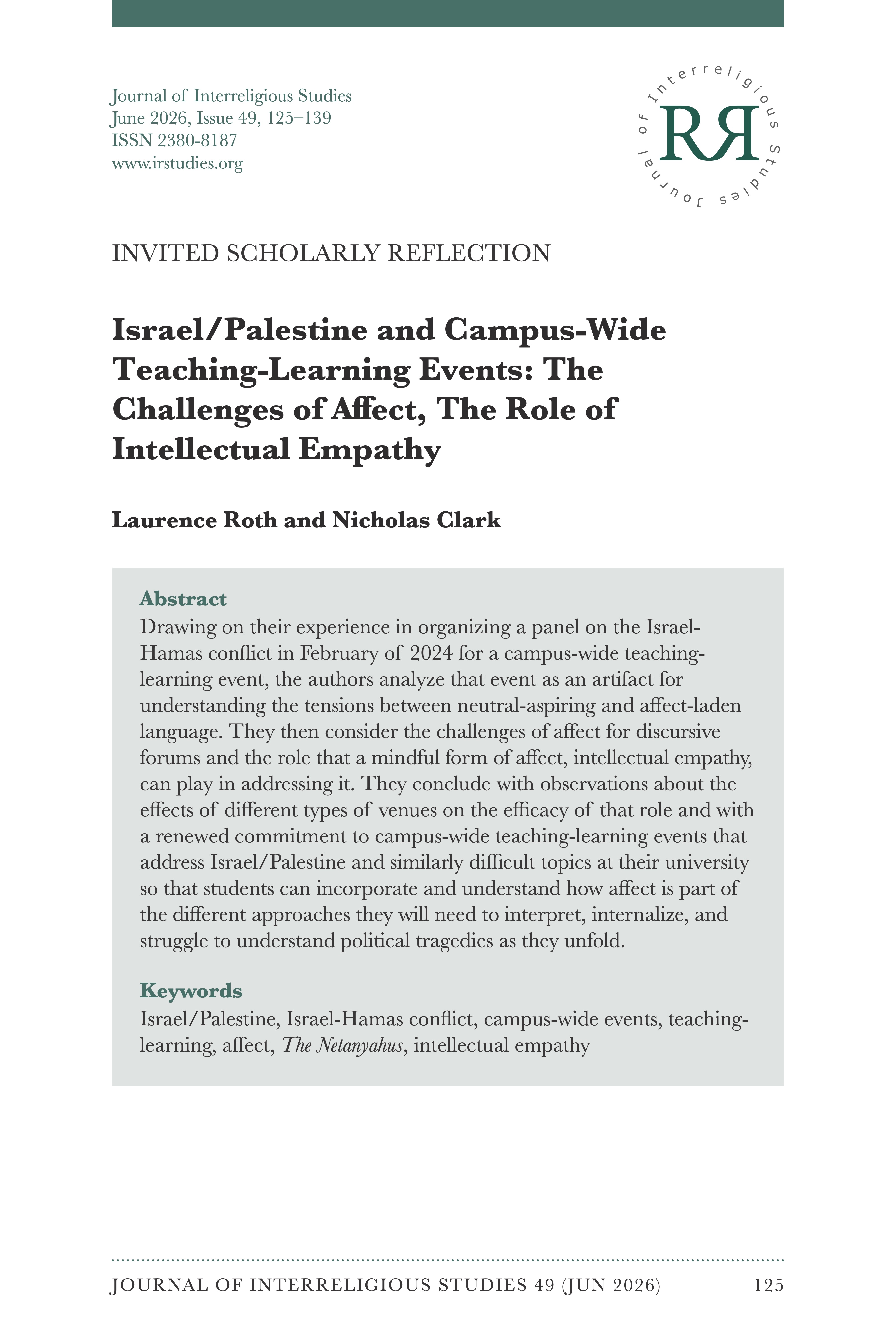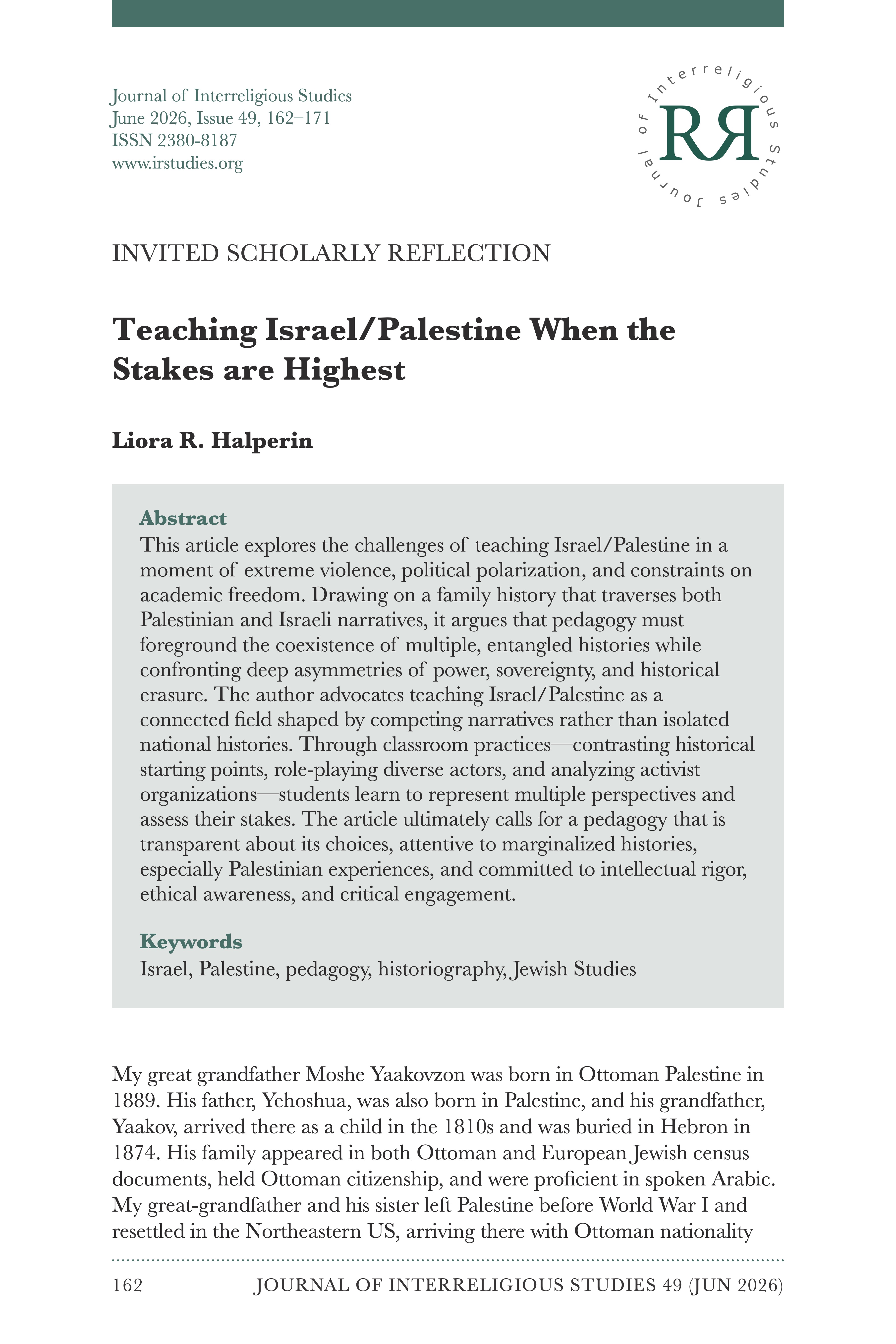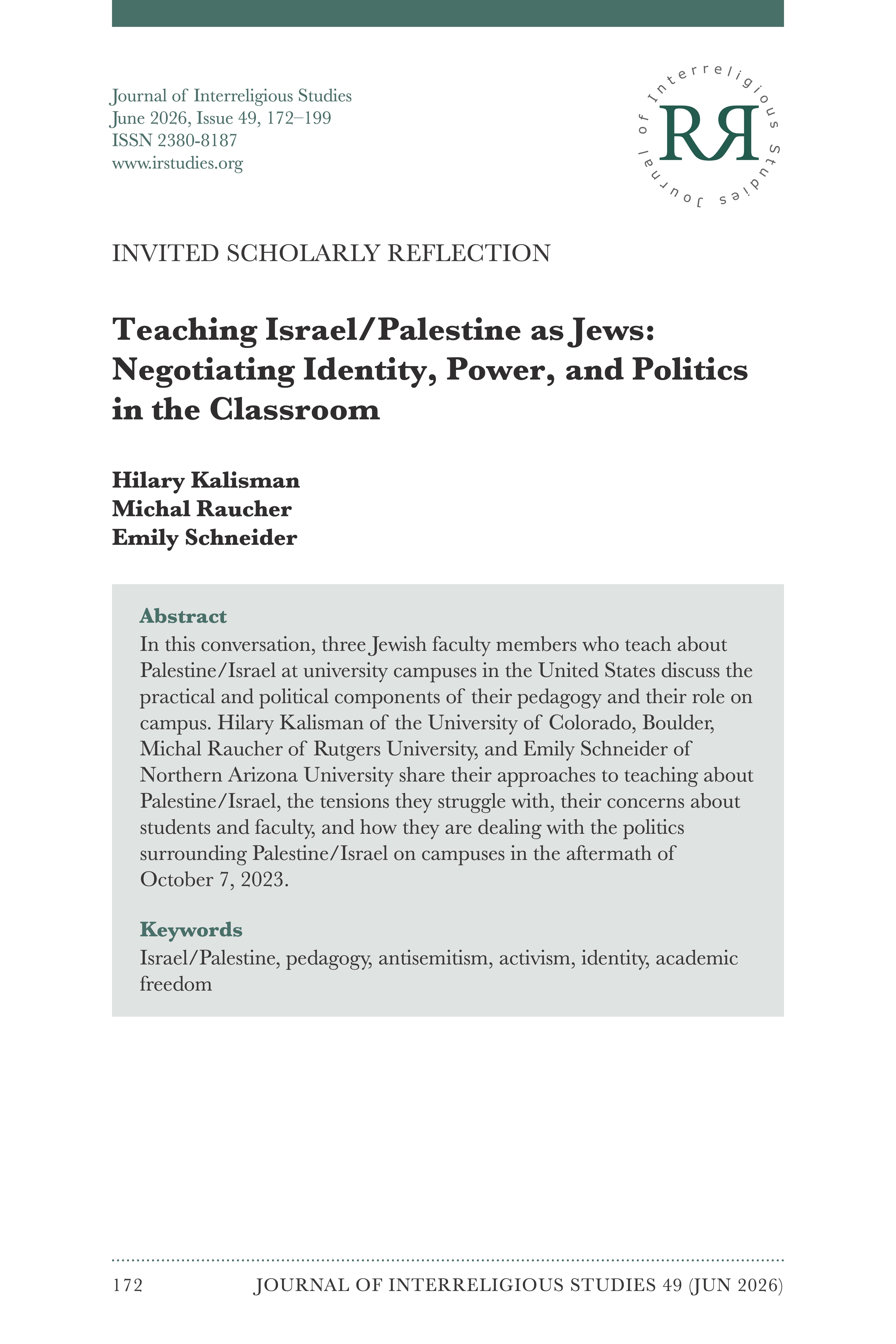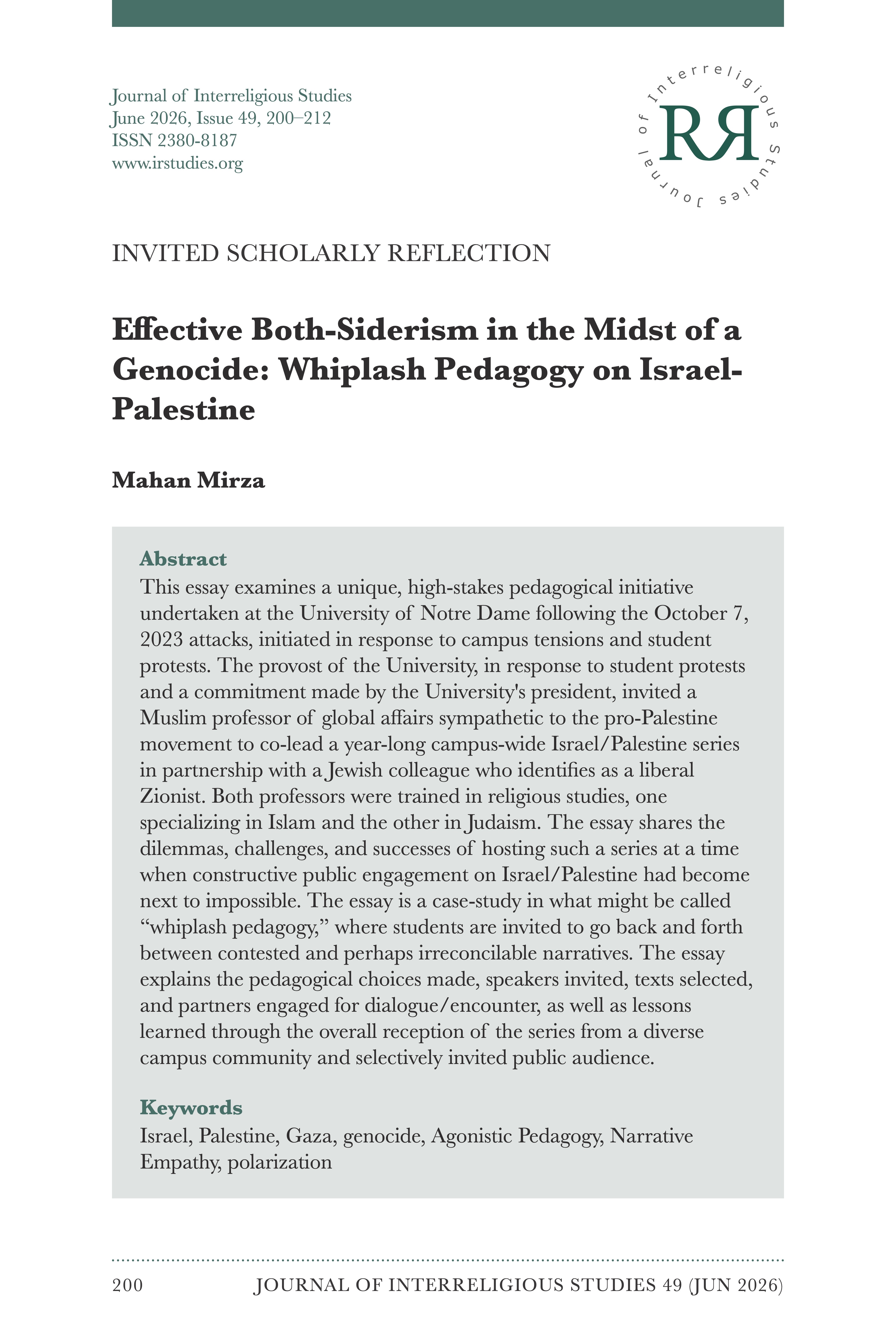
Journal of Interreligious Studies, No. 49: Teaching Israel/Palestine brings together scholars and educators responding to one of the most contested subjects on contemporary university campuses: how to teach about Israel/Palestine in a time of war, intense polarization, and threats to academic freedom. Emerging from a 2025 symposium at Elon University's "On the Edge" series, the special issue was proposed and guest edited by Geoffrey D. Claussen, Barış Kesgin, and David J. Marshall, whose introduction frames teaching Israel/Palestine as teaching relationships and conflicts-rather than separate national narratives-and as work that must grapple with justice, liberation, and the persistence of learning in hostile climates. This special issue emerged in the context of the ongoing war in Gaza, protests and encampments, uneven institutional responses, and a public discourse often marked by vitriol, oversimplification, and accusations of bias or "false equivalence." Against this backdrop, the issue offers critical, constructive, and generative reflections and peer reviewed articles that arise from concrete classroom and campus organizing experiences. Contributors from Religious Studies, Political Science, History, Geography, Jewish Studies, and other fields explore comparative frameworks, subversive pedagogies, graphicnarratives, music, campus wide events, interreligious dialogue, and the emotional and political stakes of teaching when "the stakes are highest." Across these diverse essays, the special issue highlights the ethical and pedagogical commitments shared by its authors: engaging students deeply and critically rather than leaving them paralyzed by controversy; attending to affect, narrative, and identity; exposing the limits of "balance" and one off events; and building community and solidarity in the face of surveillance, harassment, and professional risk. The issue aims to elevate the conversation around teaching Palestine/Israel by offering academically rigorous, reflective scholarship and inviting further debate, rather than ceding the terrain to reductive or polemical treatments.
Available digitally open-acess or in print for purchase.
 Journal of Interreligious Studies, No. 49: Teachin ....
Claussen, Geoffrey D. and Marshall, David J. and Kesgin, Barış
Buy Now
Journal of Interreligious Studies, No. 49: Teachin ....
Claussen, Geoffrey D. and Marshall, David J. and Kesgin, Barış
Buy Now
Published: 2026-06-24
Full Issue
Editorial Introductions
Articles
Invited Scholarly Reflections